Decision and ownership
State the decision required, decision owner, deadline or timing constraint, strategic outcome, and accountable owner for the next step.
Framework & Playbook · Free
A practical operating model for turning competing demand into visible choices, accountable commitments, and measurable outcomes.
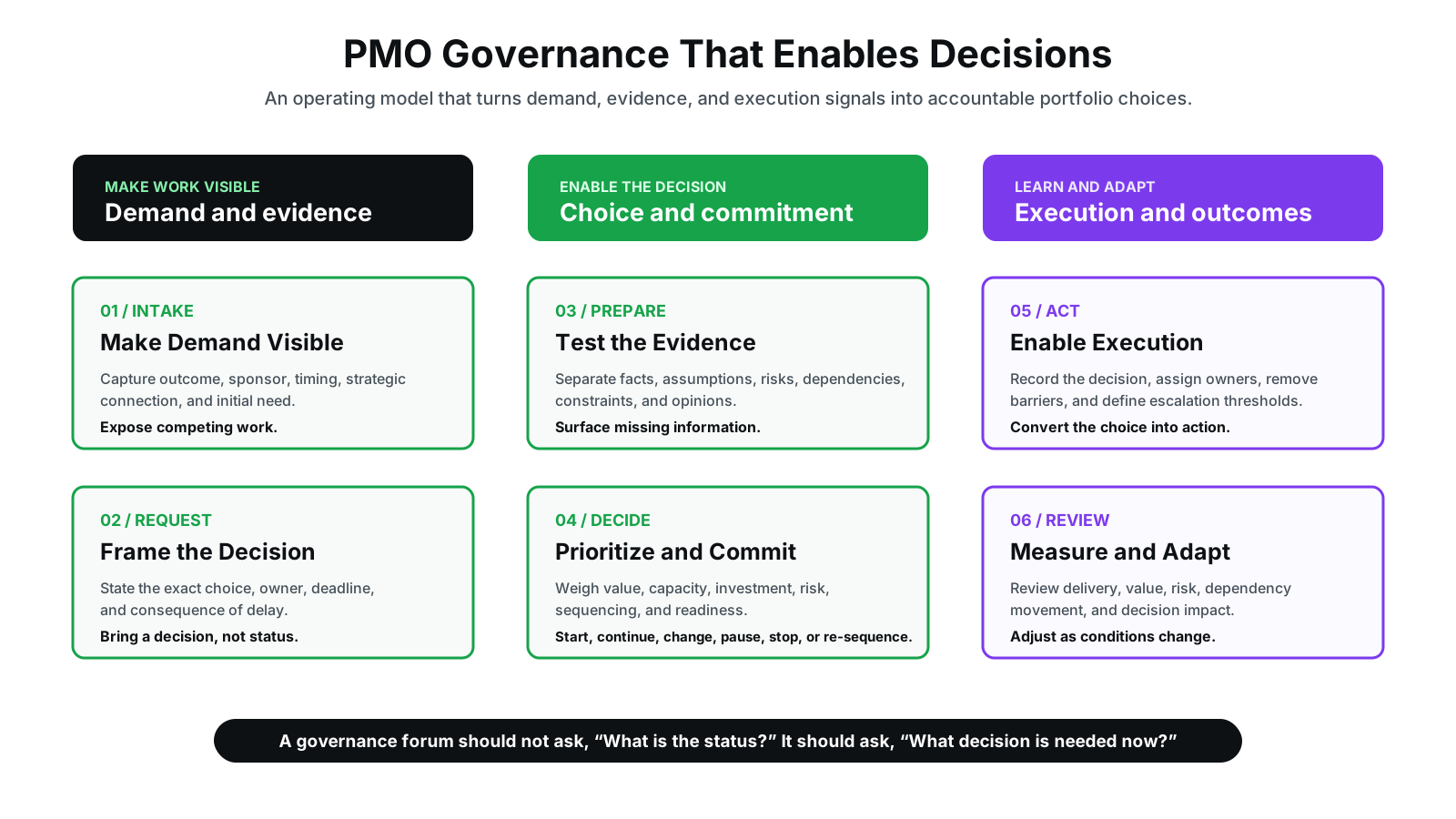
Governance is not a tollgate. It is the operating discipline that helps leaders decide what to start, continue, change, pause, or stop. A good PMO does not exist to produce more status reporting. It makes choices visible, evidence-based, timely, and actionable across a portfolio where demand will always exceed available capacity.
That means every material item should arrive with a defined decision, a named decision owner, relevant evidence, available choices, and a consequence for delay. The output is not a fuller dashboard. It is an accountable commitment: what will happen next, who owns it, and how leadership will know whether the decision improved the outcome.
A status update describes activity, progress, issues, and forecasts. It is useful for delivery management, but it does not automatically require executive attention. A decision brief identifies a choice, the evidence behind it, the consequence of each path, the owner who can decide, and the action required after the decision.
Governance becomes inefficient when every item receives the same level of attention. The PMO should route routine delivery management to the teams closest to the work and elevate only material decisions, risks, dependencies, and tradeoffs. A senior forum should not spend its time reading milestones aloud. It should resolve the few choices that cannot be made well elsewhere.
Use the cycle above to create a consistent path from demand to outcome. First, make demand visible before it becomes a hidden commitment. Then frame the exact choice, owner, timing constraint, and impact of delay. Test the evidence so facts, assumptions, risks, dependencies, constraints, and opinions are not blended together. Prioritize and commit by weighing value, capacity, investment, risk, sequencing, and readiness.
Execution follows only after the decision is recorded, barriers and escalation thresholds are clear, and accountable owners know the next step. Finally, measure delivery, value, risk, and decision impact, then adapt the portfolio as conditions change. AI can help organize evidence, identify missing information, and standardize decision preparation; human leaders still own prioritization, tradeoffs, escalation, and decisions.
A decision-ready item is concise enough to discuss and complete enough to act on. It should make uncertainty visible rather than disguising it as confidence.
State the decision required, decision owner, deadline or timing constraint, strategic outcome, and accountable owner for the next step.
Show material facts and sources, assumptions, risks, dependencies, constraints, and what information is still missing.
Present available choices, a recommended path with rationale, and the effect of each option on value, capacity, risk, timing, and investment.
Explain the impact of delay or inaction, then record the action, due date, and follow-up measure that will prove whether the decision worked.
FARO means Facts, Assumptions, Risks, and Opinions. It is a simple way to prevent executive decisions from being driven by confidence, politics, or incomplete reporting. FARO does not remove judgment; it improves the quality and transparency of the inputs leaders use to apply judgment.
| Element | Meaning | Governance question |
|---|---|---|
| Facts | Verifiable information supported by a known source. | What do we know? |
| Assumptions | Conditions treated as true but not yet verified. | What are we assuming? |
| Risks | Events or conditions that could affect delivery, value, timing, or outcome. | What could change the result? |
| Opinions | Views, preferences, or recommendations not yet supported by evidence. | What needs validation? |
Use FARO while the decision is being prepared, not as a ritual after the recommendation is fixed. It prompts a useful conversation: which claims can be checked, which conditions could change the result, and which preferences still need evidence.
Work is aligned, ready enough, and worth the investment.
Current direction remains valid and delivery is within acceptable limits. Continue is still a decision, not the default.
Alter scope, approach, ownership, funding, timeline, or delivery method.
Preserve the work but change timing because of capacity, dependency, or priority conflict.
Hold work intentionally pending a condition, decision, or readiness requirement.
End work that no longer supports the required outcome, value case, or risk position.
Weekly: review delivery exceptions, material risks, dependency movement, and urgent decisions. Monthly: review portfolio priorities, capacity and investment tradeoffs, decision follow-through, and forecast changes. Quarterly: reassess strategic alignment, portfolio mix, value realization, funding choices, major dependencies, and work that should be stopped or re-sequenced.
The cadence should be predictable, but the routing should be selective. Escalate an item when a decision crosses a defined authority boundary, a dependency cannot be resolved by the delivery teams, or the consequence of delay is material.
Protect the agenda. If an item has no decision, no material exception, and no request for help, send it to the appropriate operating forum instead. This creates room for the tradeoffs that require leadership judgment.
Good governance measures more than on-time project delivery. Track time from issue identification to decision; the percentage of material items with a named owner and documented decision; decision follow-through and action completion; aging risks and unresolved dependencies; portfolio capacity or investment conflicts resolved; work paused, stopped, re-sequenced, or avoided; and the business outcome, benefit, or risk impact after a decision.
These measures show whether governance is improving the organization’s ability to choose and act, not merely its ability to report. A missed date can be visible in a dashboard; a delayed decision and its consequence should be equally visible.
No. Delivery management remains essential. This framework helps the PMO route routine delivery work appropriately and focus executive forums on decisions, tradeoffs, and material exceptions.
The owner should have the authority to make the choice or to escalate it through a known path. The PMO prepares and maintains the decision record; it should not quietly inherit executive decision rights.
Often, yes. FARO makes the uncertainty visible so leaders can decide whether to act, gather more evidence, reduce exposure, or pause until a condition changes.