Data
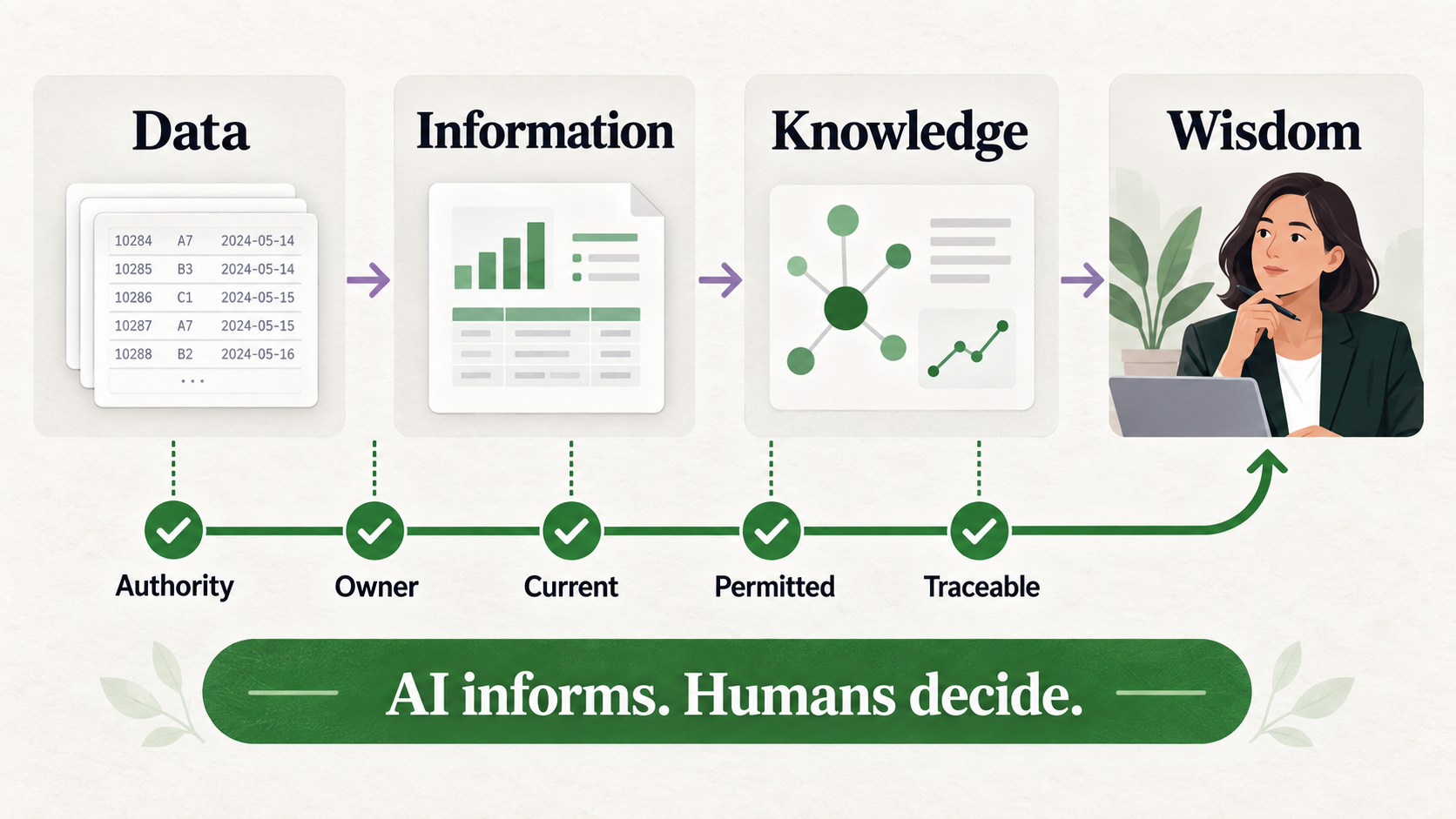
Raw facts, records, events, fields, and documents. AI can retrieve, classify, and structure them; people define quality and permitted use.
Interactive Framework · Free
A practical framework for deciding which organizational information AI may use—and where human judgment must remain.
Choose one source and answer from the evidence available to you. Do not paste documents, names, or sensitive material into this page: the check is button-based, runs only in your browser, and does not store or transmit answers. The result is a practical discussion aid, not a certification or audit. Use it to set a safe first boundary: can AI retrieve from the source, summarize it with citations, help a person compare it, or should the organization first improve the source itself?
Repeat the check for the specific intended use. A source might be suitable for a human-reviewed summary of current facts but not for an automated decision. The right answer depends on decision risk, permitted use, and whether a reviewer can trace an important claim back to the original record.
AI can organize, summarize, and reason over information. Humans still own wisdom: judgment, accountability, tradeoffs, values, and the decision about what should happen next. That distinction is practical, not academic.
Raw facts, records, events, fields, and documents. AI can retrieve, classify, and structure them; people define quality and permitted use.
Data organized with context. AI can summarize and explain what happened; people validate meaning and relevance.
Validated patterns, rules, context, and lessons. AI can surface patterns and apply defined rules; people confirm context, exceptions, and applicability.
Judgment under goals, constraints, ethics, and risk. AI can provide evidence and challenge assumptions; people own the decision and accountability.
An AI may answer fluently from a data set, but data alone does not tell it which tradeoff an organization should make. A model cannot quietly inherit the authority to approve an exception, decide a customer impact is acceptable, or choose between competing values.
Certified sources beat excellent prompts built on questionable information. A trustworthy source is authoritative for the question, has a business owner, is current enough for the decision, has understood definitions and gaps, and is explicitly permitted for the intended AI use. A usable workflow also makes source references and timestamps visible. When information is absent, stale, or conflicting, the AI should say so rather than guess.
Traceability turns a plausible answer into a reviewable one. A person should be able to follow an important answer to a record, version, date, policy section, or report. Conflict handling matters for the same reason: organizations often have multiple systems or documents that look credible but disagree. Define which source wins, who resolves the disagreement, and when the workflow pauses.
A spreadsheet is not automatically untrustworthy, and a database is not automatically safe. A manually maintained Excel file can be useful when it has a known owner, a clear purpose, version history, and a reconciliation process. A system of record can still mislead if fields are poorly defined, refreshes fail, or the AI use exceeds its permitted boundary. The assessment asks about governance and evidence rather than rewarding a particular format.
Start with grounded answers and human review before allowing information to trigger actions or automation. Sensitive or restricted information needs explicit boundaries even when it is accurate. An approved policy may be an excellent source for explaining current rules; it does not necessarily authorize an AI to decide an exception to those rules.
AI can make evidence easier to find and assumptions easier to challenge. It can compare an approved set of options against criteria people set. It cannot own the downstream consequence. A human approves changes, resolves conflicts, and takes responsibility for consequential decisions. That is especially important when the work affects people, money, service, compliance, reputation, or safety.
Make this visible in the workflow. State what AI may use, what it must cite, what uncertainty looks like, who reviews the result, and what happens when sources conflict. These controls help teams learn from real work without treating a polished output as unquestioned truth.
No. It is a practical source trust assessment for a single intended use. It does not certify a source or replace legal, privacy, security, records, or compliance review.
Often, but only for constrained work such as summarizing, extracting, comparing, or preparing material for human review. Show the source basis, caveats, and uncertainty rather than treating the output as final fact.
Not by itself. Automation also needs a bounded action, defined rules, an exception path, traceability, and a human owner. Start with grounded answers and review before expanding authority.
Pause the affected conclusion, expose the conflict, and follow the defined conflict rule. If no rule exists, assign a qualified owner to resolve it before AI output is used as a basis for action.